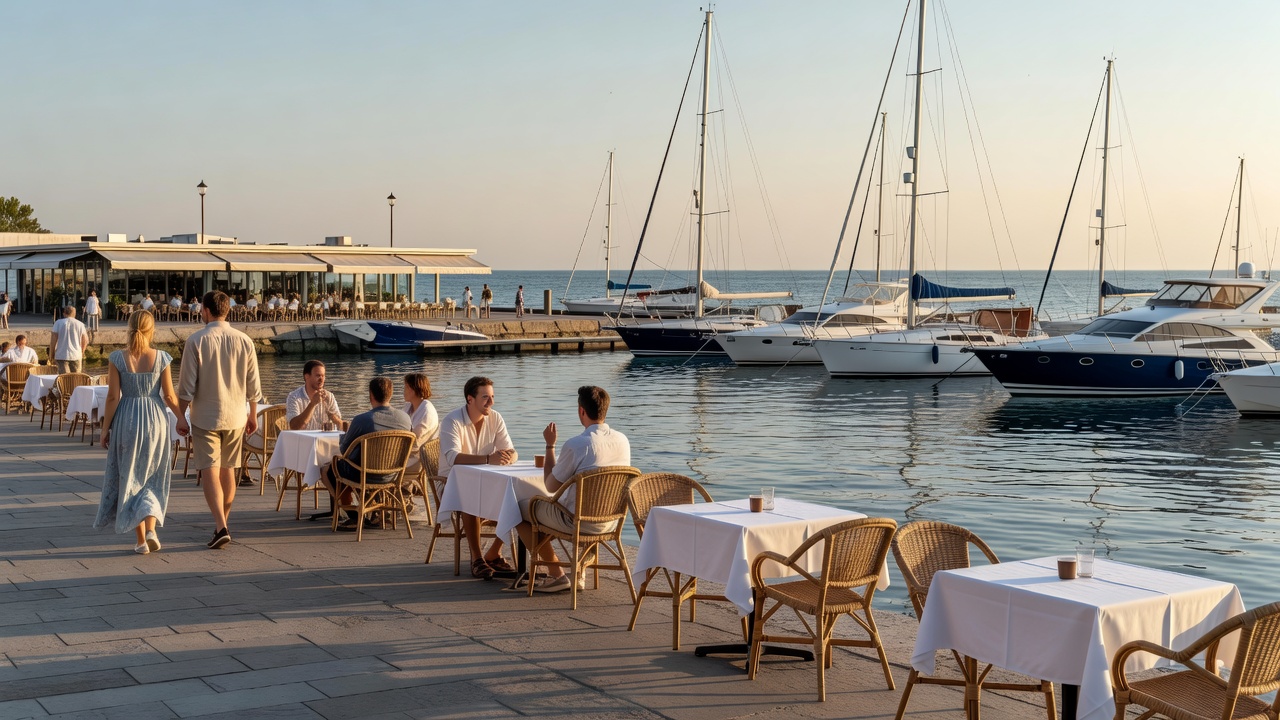
Choose a day before you choose a room
Imagine a day without a major excursion. Would you like to walk to a bakery, spend time beside working boats, visit a museum or read somewhere quiet? That answer gives you a more useful starting point than a photograph of a bed facing water. Floating accommodation is a base within a neighbourhood, and the neighbourhood continues to matter when the novelty of the room becomes familiar.
An urban marina may offer public transport and restaurants while also bringing traffic, evening activity and public footfall. A more isolated berth may provide a slower setting but require a car, a longer taxi journey or more planning for meals. Check the actual walking route, not a straight-line distance. Gates, basins and restricted areas can make a nearby destination surprisingly indirect.
Consider the return journey as carefully as the outward one. A pleasant waterfront walk in daylight can feel different in rain, after the last bus or when a seasonal restaurant has closed. Ask about year-round services and late arrivals rather than assuming summer photographs describe every month.
Use places as context, not promises
Edinburgh’s Leith and the Water of Leith help explain the attraction of a waterfront district connected to a larger city. They do not establish that any particular room there floats. Brighton Marina offers another kind of setting, where the marina environment and the wider city require separate consideration. In Southampton, Ocean Village places marina activity within an urban waterfront. Each name is a starting point for checking a neighbourhood, not an endorsement of accommodation.
Farther afield, Hamburg’s HafenCity and Oslo’s Aker Brygge illustrate waterside city life with very different histories and patterns of development. Copenhagen’s Christianshavn and Rotterdam’s Rijnhaven offer further contrasts in how people live beside or on water. A hotel described as “near the marina” might still be a conventional building some distance from a berth.
Separate destination appeal from availability, licensing and suitability. We do not maintain live room inventory or certify the status of individual operators. Use official destination and transport information for current practical details, then confirm the actual accommodation arrangement directly with the provider.
Turn the listing into a written checklist
Start with identity: the exact property name, operator, unit type and location. Establish whether you are reserving a specific room or a category allocated later. That distinction can affect views, pontoon distance, neighbouring activity and access. If a particular feature is essential, ask for it to be recorded in the booking rather than left as a preference.
Next, work through the total cost and service pattern. Check taxes, cleaning charges, parking, breakfast and any deposits or payment schedule. A small property may not offer continuous reception, daily housekeeping or luggage storage. Those differences can be perfectly acceptable when known in advance and frustrating when discovered at the gate.
Read cancellation and disruption terms separately. Your decision not to travel, transport disruption and an operator being unable to provide the booked accommodation are different situations. Ask what happens if safe access is unavailable, if the unit becomes unusable or if a proposed alternative does not meet your stated access needs. Keep the written answer and your booking confirmation.
Do not assume travel insurance covers a particular event simply because water or weather is involved. Read the policy and ask the insurer about relevant exclusions. For payments, use the operator’s verified booking route and be cautious if asked to transfer money to an unexpected account.
Compare the same things
Reviews are most useful when they describe specific conditions: the route from the gate, a recurring sound, the responsiveness of staff or the temperature of the room. A rating without context cannot tell you whether the property matches your needs. Look for patterns across recent accounts and remember that a different unit or season may produce a different experience.
Environmental claims also benefit from detail. “Eco-floating” is not a performance measure. Ask about energy use, wastewater arrangements, materials and how information is measured. A floating location can be thoughtfully operated, but the location itself does not demonstrate a smaller footprint than a hotel ashore.
Finally, leave room for preference. Some travellers enjoy the activity of a shared pontoon; others want to draw the curtains and hear very little. Neither is the correct way to stay near water. The aim is to find an honest match between the place and your expectations, not to prove that you can adapt to every inconvenience.
If an operator gives clear, specific answers, a modest room may be a stronger choice than a spectacular listing full of evasions. The right berth is the one whose practical reality still appeals after the photograph has done its work.
| Priority | Evidence to request | Why it matters |
|---|---|---|
| Access | Complete route and relevant measurements | A room description may omit the gangway. |
| Sleep | Unit position, nearby activity and blackout provision | Marina conditions vary within one site. |
| Neighbourhood | Actual gate-to-transport and dining routes | Map proximity may hide a long walk. |
| Disruption | Written access and accommodation contingency terms | Different causes may have different remedies. |