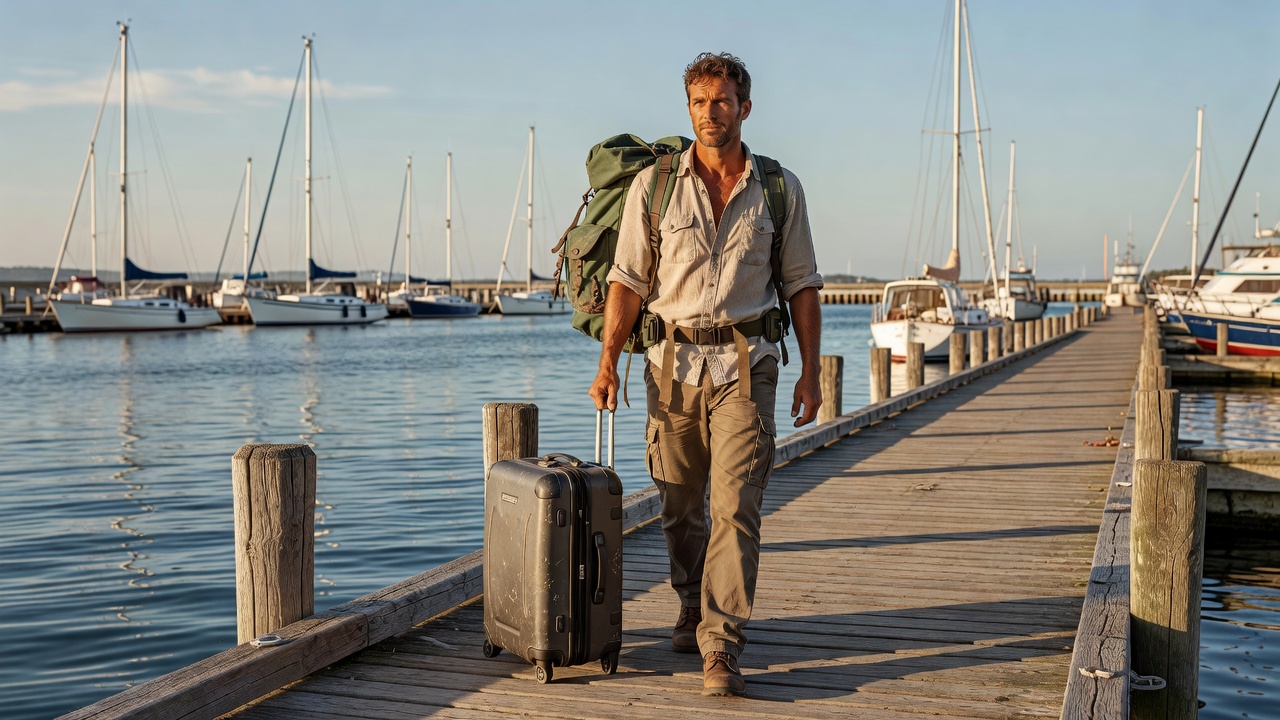
Begin where the taxi stops
The address on a booking confirmation may identify a marina office rather than the entrance you need. Before travelling, establish the precise drop-off point, the gate used by overnight guests and the distance to reception. Check whether a driver can enter the site, whether parking requires a separate arrangement and whether there are surfaces that make wheeled luggage awkward.
Ask for directions that describe the route rather than relying entirely on a map pin. A public waterfront path can run close to a room while the actual marina gate sits much farther away. After a delayed train or flight, that difference matters. Save arrival instructions somewhere available offline, along with a telephone number that is answered during your expected arrival window.
Travel light where practical, but do not assume that a small suitcase solves every difficulty. Boarding assistance should be arranged, not guessed at. Ask who can help, during which hours and whether the help involves carrying bags only or also supporting a particular access need.
A useful access answer has measurements
“Accessible” is too broad to describe every guest’s needs. Request information about the entire chain: parking or drop-off, gates, paths, gangway, pontoon, entrance, internal circulation, bathroom and evacuation route. A step-free room is not enough if its approach includes steps. Likewise, a level approach does not guarantee turning space or an appropriate shower inside.
Ask for clear door widths, threshold heights, surface descriptions and relevant bathroom measurements. For a gangway, ask about its usable width, handrails, surface and the range of slopes expected during your visit. In tidal settings, the most comfortable arrival time may not reflect the conditions you will encounter when returning from dinner. Do not accept a single favourable photograph as a complete access statement.
Explain your functional requirements in terms you are comfortable sharing; you do not need to provide an unnecessary medical history. A wheelchair user, a person with limited balance and a traveller with low vision may need very different information. Written answers help both sides check that the same arrangement is being discussed.
- Request the route at different water levels, not just at check-in.
- Confirm resting places, lighting and non-slip surfaces.
- Check whether assistance must be booked in advance.
- Ask what happens if a gate, lift or access system fails.
Comfort includes movement and temperature
Movement is not a simple yes-or-no feature. A broad floating platform in sheltered water may feel different from a converted vessel near regular traffic, but a description alone cannot predict your response. Tell the operator if you are particularly sensitive and ask about the actual unit, its location and recent guest feedback. If a medical condition affects your decision, seek individual advice from an appropriate clinician rather than treating travel copy as health guidance.
Heating, cooling and ventilation deserve equally ordinary questions. Large windows can make a room bright while increasing heat gain. A waterside breeze does not mean windows can remain open safely or quietly all night. Ask how the room is ventilated, whether temperature controls are individual and whether the bathroom has effective extraction.
Think about the bed and bathroom as practical spaces, not just photographs. Check bed access on the side you need, shower entry, grab-rail provision and whether any internal step separates the sleeping area from the toilet. For a short stay, a small inconvenience may be manageable; for a longer visit, it can shape every day.
Make the evening route part of the plan
Walkway lighting, gate controls and emergency arrangements matter after sunset. Ask whether reception is staffed overnight or whether support is provided remotely. Establish how to contact help from the room and where guests assemble if evacuation is required. Never assume the route used in an emergency is identical to the comfortable daytime entrance.
Children need close supervision around open water, and pet policies should be checked before booking. A terrace is not necessarily enclosed, and a pontoon is not a play area. Ask about any property-specific age restrictions, lifejacket arrangements and animal rules directly; there is no universal policy for all floating accommodation.
UK travellers may encounter access information informed by the Equality Act 2010, while BS 8300 provides a recognised reference for inclusive built-environment design. Neither reference proves that a particular floating room meets your requirements, and requirements differ outside the UK. The AccessAble directory can provide detailed access information for some destinations and venues, but a listing elsewhere does not certify your chosen accommodation.
A useful host does not need to promise that every room suits everyone. They need to describe the situation clearly enough for you to decide. If key details remain vague, choosing another property is a reasonable planning decision, not a failure of adventurousness.